Women Who WOW: Lesh (@therainbowwheelie) on Pride, Privilege, and Living Out Loud
Updated: Jul 1
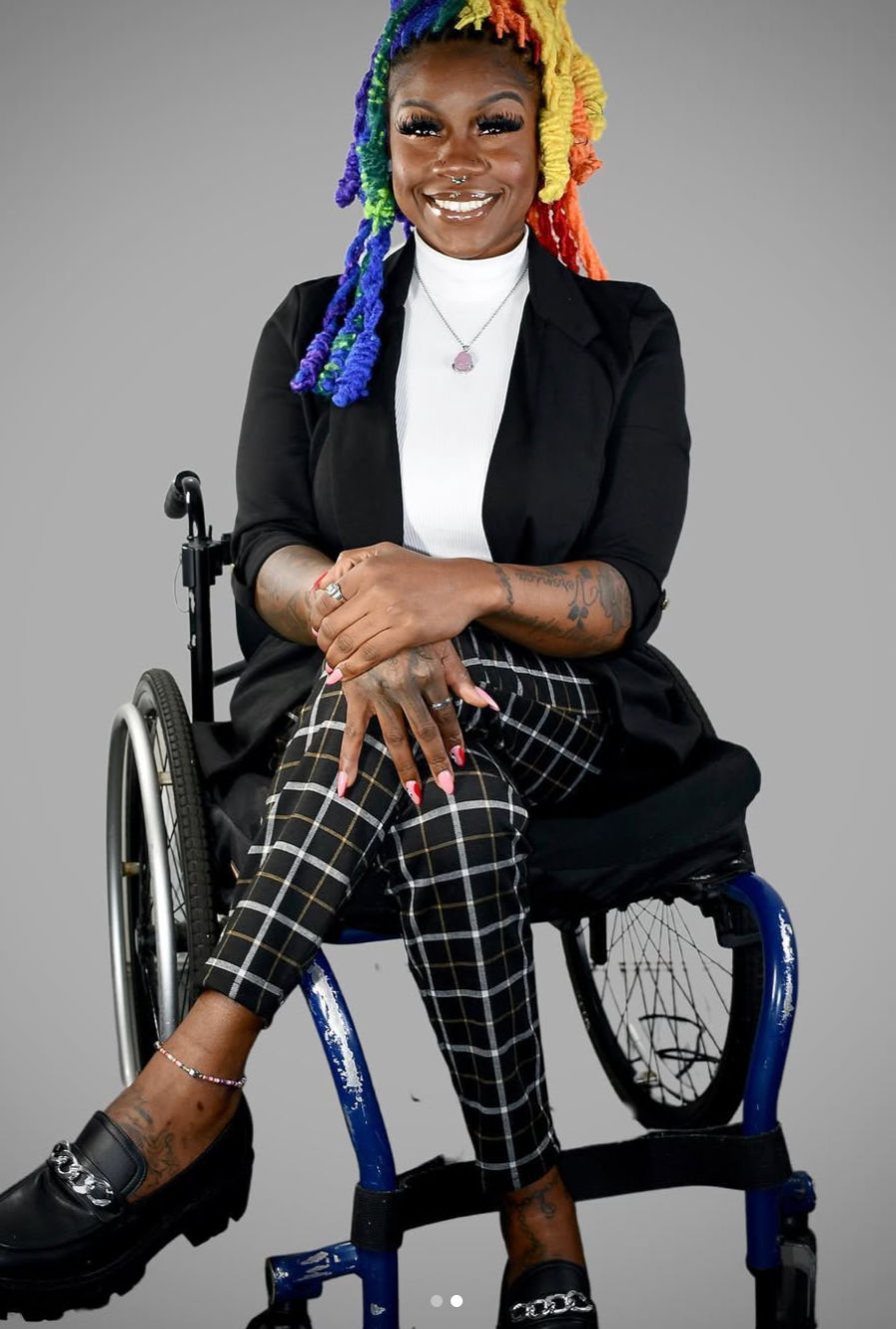
This Pride Month, we're shining our community spotlight on Lesh, known to many of you as @therainbowwheelie!
Lesh is part of the community of women navigating life with spinal cord injuries. As a Black, queer woman in a wheelchair, she lives at the intersection of several identities that don't always get to share the spotlight together.
We sat down with Lesh to talk about identity, intimacy, advocacy, and what authentic representation actually looks like. Her answers are honest, funny, and unflinching, which is exactly how she lives. Here's our conversation.
How has being part of the LGBTQ+ community shaped your experience and identity as a wheelchair user with SCI?
My partner's name is Kay. She's the only woman I've ever dated, actually. We started dating two months before my injury. So this has always been part of my identity, especially since I had to assume a new one when I broke my back, if you will. Once I acquired my injury, obviously everything changed. But when it comes to my sexuality, I guess the label changed too. For me, I've always been fluid. I wouldn't say it's necessarily changed my experience as a person with an SCI, because it is what it is. I don't tolerate disrespect, period, and I'm not disrespectful either, unless it's brought to me first. I treat people how I want to be treated. Because of who I am, and who my partner is, there's really no reason for it to make a difference in how we move through the world.

I sometimes have to stop and give myself my own flowers, because I've accomplished a lot in seven years. And I realize that's also a privilege, being part of the SCI community and the LGBTQ+ community means I'm holding a lot of intersecting identities. I've had friends in the community who've had terrible experiences with discrimination or homophobia, and I haven't experienced that in the same way. I've had people give me looks, but by the end of the event, they're inviting me and my partner to their house. That's a privilege. A lot of people don't have support, and without my support system, none of this would have been as manageable. I'm not going to say it's been easy—because it ain't. Life isn't easy for anybody, abilities aside, but when you throw a physical disability into it, there's a new struggle every day.
That's why I never wanted to be one of those creators who's just like, "hey, do you want to see me transfer into my car?" If you look up a wheelchair user online, that's one of the first things you'll see (and I'm not knocking that, people need to see it) but they don't need to see that from me, because you can find that anywhere. I've never wanted to just show the pretty.
It actually wasn't until I competed in Miss Wheelchair America that I heard the term "pretty privilege." I had no idea what that was. I'd heard about European beauty standards, but I didn't realize that within the disabled community, just being able to do my hair, my nails, my lashes, being able to dress myself a certain way, was its own kind of privilege. That blew my mind. So one of my things for social media became: I'll show the pretty, sure, but I'm going to show y'all the good, the bad, and the ugly too. For me, dark humor always wins. If I'm going to show the internet who I am, I've got to show y'all who I really am, and who I am at heart is somebody laughing to keep from crying.
That's actually why I didn't choose the name "The Rainbow Wheelie" just because I love bright colors, or because I love the community. I chose it because this journey has come with so many storms. Beautiful sunsets, sunrises, sunshine and rainbows. But essentially, it takes a storm to get a rainbow. It's not just "oh, rainbows, unicorns." There are layers to it.
Can you share a moment or a turning point that shaped how you embrace your intersectional identities today?
Miss Wheelchair America. When I first got there, my only intention was to be authentically myself, and that's a Black woman first. Then, I'm physically disabled. Then, I'm in a relationship with a masculine-presenting partner. I have tattoos. I like bright colors. I wear rainbow hair. There are a lot of in-your-face things about me, and some people might think that's a lot, and that's cool, I get it. But all I wanted to do at MWA was be authentic, and love on the people who loved on me.

My partner and I do everything together. She's a huge part of my support system, she's my legs, the muscle sometimes. People see us together and see the love we share, the humor we share. So many people were complimenting how we operate as a couple, as an inter-abled couple, and also a disabled couple, because she's disabled at times too. Being there, surrounded by other women who are disabled and don't have a significant other, it really showed me how hard it is (as a woman with a spinal cord injury) to date and find someone you can actually trust with your body and your freedom. Once you're out of your mobility aid, you're kind of left to your own devices, or that person's.
Hearing their experiences, and being able to share mine and empower them—because y'all don't have to take less than you deserve just because that's what people are used to giving—that was eye-opening for me. I realized all of my privileges, but it also felt good to be able to show others: if I can do it, you can do it too.
How do you navigate intimacy as a disabled, queer person?

Definitely some humor and patience. There are so many unexpected things that can come up with a spinal cord injury. I'm a T10/T11 injury, so I don't have bladder control, and I manage that with an ostomy bag. For me, because I've been with my partner since before my injury, I feel like that's another privilege. She knew me before and after, so I never had to introduce someone new to this new body, she was already here. The only thing has been figuring out how to navigate the new logistics together.
These days I know my routine: cathing before and after, keeping the right supplies on hand just in case, making sure I've got a fresh bag, having the setup that works for both of us: extra pillows, a few adaptive pieces that make positioning easier. More than anything, it comes down to patience, and the privilege of having a partner who already knows and is comfortable with my body. I'll admit I still get a little self-conscious sometimes about how my body has changed, but we've found what works for us, and gender doesn't really factor into any of it. It's really just patience, positioning, and humor, because sometimes things happen, and that's just part of it.
If you could speak to someone newly injured who isn't in a relationship and has to navigate dating from scratch—how does someone get to a place of self-confidence and comfort after this kind of physical change?
I'd say it starts with yourself. Especially when you're newly injured, there's this idea that you need to prove who you still are to other people, and that's fine. But really, you need to prove that to yourself first. If you want to be out in the world, you have to be comfortable being out in the world. So get in the mirror. Start doing the things that make you feel good—for me, that's something as simple as a favorite scent, getting dressed up for myself, not for anyone else. Figure out what makes you feel good now, because a lot of what felt good before your injury might not feel the same afterward. You have to get to know your body again: what's working, what's not, what a muscle spasm means, what a sensation means. Once you know your body, you can tell someone, "hey, we're not doing that," or "that's not working, let's try something else." Get to know yourself first, and the rest follows.
I'll also say: be careful. Accessibility makes intimacy with someone new genuinely harder than people realize. You can't always just go to someone's place and know the bathroom or the shower will even be accessible to you. That changes the calculus on trust in a way a lot of people don't think about.
How do societal assumptions about disability, gender, and sexuality affect how people interact with you?
I always have to acknowledge that I have privilege here too. I think people see the two of us—me in a wheelchair, my partner able-bodied and masculine-presenting—and they come in with assumptions about what our roles must be. People expect her to act a certain way, or assume our relationship is some kind of "caretaking arrangement" rather than a real one. Then they get to know us, and they're like, "oh, y'all actually really love each other."
I think because we both have tattoos, she has locs, I usually have rainbow hair, people make assumptions about us, and then they're surprised when we're well-traveled, well-spoken, doing things together with no problem. It is hard work, because the world isn't built to be accessible, but it's not impossible, and I have a partner who's willing to go the extra mile to make things adaptive.

People also assume she's my only caregiver, or that I can't reciprocate care. I love being taken care of, but I also love providing care, I take that seriously. When she's been in the hospital, I've stayed the night and handled things from my wheelchair, no different than anyone else would. I think part of this, too, is being a Black woman. I've always had to be careful about how I advocate for myself, because I don't want to be read as "the angry Black woman demanding the world take care of her." That's a lot of weight to carry on top of everything else. But seven years in, I have no problem advocating for myself authentically and unapologetically anymore.
Why has advocacy around disability and queer identity become important to you personally? And what advice would you give to someone newly navigating life with a spinal cord injury?

I've always wanted to live unapologetically, and for a long time I couldn't. It wasn't until I became disabled that I actually found the freedom I'd been looking for before my injury. You get down to the raw, uncut version of yourself when you go through something that traumatic. So I had to figure out how to own who I was. I had to get to know myself as a wheelchair user and conquer that before I could conquer anything else: figuring out how I like to dress, getting my nails done the same way I always had, even getting my lashes done while I was still in rehab.
That's honestly my advice to anyone newly injured, too: start by becoming aesthetically pleasing to yourself, not for anyone else. There are so many beauty standards that disabled people get excluded from, simply because we're disabled. And that drives me nuts, because using a mobility aid doesn't make you any less worthy or any less beautiful. But until you're comfortable enough to say, "I'm the baddest bitch in this room, sitting down or not," it hits different. I'm literally taller than most people sitting down, and I stand on that. You have to get comfortable with yourself first, not necessarily to make everyone else comfortable, but to set the standard for how you expect to be treated.
What does authentic representation of disabled, LGBTQ+ people in media look like to you? Where are the gaps?
There need to be changes. the representation we have for disabled people as a whole lacks depth. It tries to make disability one-size-fits-all, and that's never the case. When it comes to the queer side of things, we rarely get any media representation unless it's tied to something tragic, or framed as inspiration porn. There's no real representation, because it's always tangled up with something else. The disability always trumps everything.

What I want to see is more love out in public. People not being afraid of public displays of affection with their partner, because there's going to be homophobia no matter what, and people are just going to have to deal with it, because love is love. I think people are afraid to live out loud because of all the barriers and backlash that can come with it — being a person of color, a woman, and adding a visible disability on top of that is already a lot to carry. Adding sexuality or fluidity into the mix means even more targets on your back. But when you do live in your truth, it empowers other people. If that representation existed without always being tied to something else, I think it would be a lot more accurate, and it would let people know that disabled people want to have a good time too, not just survive.
Have you found community or supportive spaces that affirm your multiple identities — outside of your relationship?
Yes. I was involved in a wellness community for a long time before my injury, and when this first happened, they rallied around me so hard: picking me up, getting me places, making things accessible whenever they could. I also had the privilege of going to the Shepherd Center for rehab, which is honestly a huge blessing I didn't fully recognize until I got more involved in the disability community. Through Shepherd, I've made connections across a lot of different organizations: adaptive sports groups like Cadillac Sports, where I ended up doing a triathlon, the Atlanta chapter of United Spinal, even a local dance studio that welcomed me with open arms. All of that helped me build the confidence to navigate different spaces—disabled or not—on my own, not just with my partner by my side.
What's one thing you wish more people understood about the intersection of disability and your queer identity?

The human experience encompasses many, many things. That's it. That's really it.
Lesh, thank you for trusting us with this conversation — and for showing this community, every day, what it looks like to live loudly, fully, and unapologetically in every part of who you are.
You can follow Lesh's journey at @therainbowwheelie.
This is the third installment of our 2026 community spotlight series — last month we featured a conversation on motherhood and SCI. Know someone whose story belongs here? [Reach out to us].


Comments